Pages

Showing posts with label awful library books. Show all posts

Jun 12, 2012

The Humans Who Went Extinct

There has been a lot of new information from the Paleoanthropological world of late regarding our much maligned cousins, the Neanderthals.  I have a soft spot in my heart for these guys and gals instilled by my physical anthropology undergrad past examining their generous occipital bun, small chin, large nasal opening and famous, short, sloping forehead represented in the skull casts that I used to handle.  And recently I read a fairly decent little book on our cousins entitled, The Humans Who Went Extinct: Why Neanderthals Died Out and We Survived.  The author, Clive Finlayson, is the Director of the Gibraltar Museum and adjunct professor for the University of Toronto.  Finlayson is situated in the perfect geographic region to discuss the extinction of the Neanderthals,  the caves dotting Gibraltar are the last place on Earth where the Neanderthal's lived; pushed to very edge of Europe before dying out 25,000 years ago. But pushed by what?  The recently arrived fully modern Homo sapiens?  Or a changing climate?  And why would an incredibly successful species that had been denizens of Europe for 600,000 years just fade away.
In the book the author deftly recreates the forested world in which the Neanderthals lived.  And this is where Finlayson's strength as an ecologist shows through.  He believes that the Neanderthal were a species that thrived in forested areas as ambush hunters.  This goes against the conventional picture of a singularly, cold adapted species with long body and short appendages living on the wind ravaged steppe just in sight of an encroaching glacier.  It was the open steppes, replacing the the increasingly mosaic forests, that did them in and not some Ragnarok final showdown with Homo sapiens.  This theory of Findlayson's has been validated by recent evidence published in the journal Molecular Biology and Evolution suggesting that the Neanderthal population had  a catastrophic crash 40,000 years ago probably due to climate change and slowly flickered out over the next 15,000 years holed up in isolated refuges like the one found in Gibraltar.  Another belief that Finlayson expounds upon was that Neanderthal culture and intelligence was much more complex than tradition held, based on modified shells that could have been used for decoration.  This has also been validated by the discovery of seal paintings Nerja cave in Malaga, Spain dating back to 43,000 years ago.  This is 13,000 years before Homo sapiens arrived in the same region.
Depiction of seals in Nerja Cave, Malaga Spain
What the author gets wrong in the book is his educated guess that Homo sapiens and Neanderthals did not interbreed, or if they did it was isolated and had no impact on the modern human genome.  Almost immediately after the book was published the analysis of the Neanderthal's  and the newly discovered close cousin of the Neanderthal the Denisovan's, DNA findings were released.  This rocked the paleoanthropological world (and my Anthro-armchair world)  with data that proved that modern Europeans and Asians shared 2.5 percent of their DNA with Neanderthals and that modern people from Oceania shared up to 5 percent of their DNA with the Denisovans! (The only Denisovan bone ever found was the pinky of a young girl in a cave in Siberia, crazy eh?).
Possible Neanderthal modified shells
But this is a great book for the curious soul who wants to know more about the increasingly clear picture of human origins. But the title is now incorrect because the Neanderthals never went extinct, but still exist in most of humanity's genetic makeup.

The Best Books I Read in 2011, Part II

                1491: New Revelations of the Americas before Columbus by Charles C. Mann is a singular accomplishment.  Yes that’s what I said and it is not hyperbole.  In my former life I dabbled in anthropology, well I got a BA in physical anthropology and was going to Nepal at one point with my mentor to study high altitude adaptations, but life intervened. Later I became more interested in archaeology and Southeastern Native Americans.  This led me to  work with an archaeologist doing phase I surveys and more recently I took graduate classes in archaeology and did lab work and field work so I logically went into library science.  Those are my less than stellar anthro credentials but its concepts are always at work in my mind and they have a great influence on my view of the world.  Given that, the book 1491 was on my radar screen when it came out, why it took six years for me to read it was due to my wariness about reading a book written by a non-anthropologist that attempts to tackle the most fought over and controversial concepts of the prehistoric and protohistoric eras of two continents.
            It turns out that Mann was the perfect person to tackle these concepts.  The reason is that besides being an erudite and extraordinarily well read science writer, he doesn’t have a dog in the hunt so to speak.  Anthropologists are some of the most savage infighters of any discipline.  Researchers cling to their pet theories to their last death rattle and many times in the face of overwhelming contrary evidence.  It is not rare in the history of anthropological research to have to wait for some god of the discipline to be called home before the science can advance.  Mann begins with the relatively new revelation that the Amazon isn’t as wild as everyone believed and it was once home to many populous civilizations who cultivated the jungle like a garden.  This reality hits home when the author examines a mound in the middle of the jungle that erosion is revealing it to be made entirely of pottery sherds.  Mann asks the researcher how many sherds he thinks is in there and the researcher does a quick calculation before stating “Forty-one million.” This has been a controversy for some time whether the jungle could sustain a large civilization and scientists aligned themselves with one side or another, but the prevailing opinion until lately was that it could not. This is only one of the many changing notions of the pre-Columbus Americas.
            A pristine wilderness lightly dusted with aboriginal peoples, vacuum sealed from time is what most people imagine the Americas as being before the arrival of Europeans.  This view is now being challenged from new insights into the anthropology and archaeology of the Americas as well as reexaminations of the writings of the first Europeans in the “New World.”  Mann deftly combines history with science in his approach to the material.  The writings from the DeSoto mission, the first European expedition into the Southeast and one of the greatest horror stories of all time “he managed to rape, torture, enslave, and kill countless Indians,”  reveal that the Mississippi was “thickly set with great towns”.  But the next visitor to the same area over a century later saw the same land teeming with buffalo and no people. The DeSoto account doesn’t even mention buffalo the entire four years of the expedition.  Also, everyone has heard of the passenger pigeon, mostly because it is extinct.  There were accounts from the nineteenth century of a flock of passenger pigeons taking three days to pass overhead, yet archaeologists find almost no bones of the birds from Native American middens (trash).  Both of these animals would have been competitors with Native Americans for food and farming land.  Once the people disappeared their populations exploded.  What happened to the Indians?  It looks more and more like Indians were much more susceptible to European diseases than it had once been thought.  They had no acquired immunity (being exposed to a disease and surviving) and because of their genetic homogeneity they had less of a spectrum of responses to the European diseases. (Their genetic homogeneity also gave them an advantage over genetic diseases.  There was no cystic fibrosis, Huntington’s chorea, newborn anemia, schizophrenia, asthma, nor juvenile diabetes.) This combination left them with almost no defense in the face of small pox, measles, and influenza, which virtually wiped out a whole world of cultures that had been flowering independently from the Old World for over ten thousand years.
            I’m not even touching the surface of all the topics that Mann examines, but here is a list of some more of them: the Clovis first controversy, Mayan philosophy, Incan khipu writing (knots on a string), the fact that the Meso-Americans were the first society in the world to use the zero as well as the first to genetically manipulate an organism as they did in their creation of maize, and Peru was the second place in the world to form a government (after the Fertile Crescent, but they may, in the end, turn out to be the first).  To sum up, Mann is a maestro in his deep understanding of the pre-Columbian Americas and lucky for us he is able to share his knowledge with masterful prose.  I can’t wait to read his new book 1493: Uncovering the New World Columbus Created.

Apr 28, 2012

Structures O'books

Sure, it looks cool until you are eaten by the giant silverfish.
Book silo, just add grain.
Clever words about this book structure
Wondering what to do with your analog book collections now that your face is buried in a Kindle.  I don't know, build yourself a new house or your town's library out of them.  Or maybe just build some random useless structure (art).  It's your call.

Source Flavorwire

Feb 12, 2012

Publishers Continue to Drop out of the Library Ebook Market

On Thursday Penguin announced that they were ending their cooperation with the digital library distributor Overdrive.  This brings the count of publishers refusing to work with Overdrive to 5.  This brings the count of publishers who will work with Overdrive to 1, Random House.  And before you go and start singing their praises, Random House has announced that they are raising their prices in March.  This price increase is one factor that caused Penguin to drop out. Here is the ALA's announcement of the Penguin's reasoning

A key issue that arose in each meeting is the degree to which “friction” may decline in the ebook lending transaction as compared to lending print books. From the publisher viewpoint, this friction provides some measure of security. Borrowing a print book from a library involves a nontrivial amount of personal work that often involves two trips—one to pick up the book and one to return it. The online availability of e-books alters this friction calculation, and publishers are concerned that the ready download-ability of library ebooks could have an adverse effect on sales.

 Another factor in Penguin's decision was its displeasure with Overdrive's third party affiliations, especially with Amazon.
Our friends over at  the Digital Shift have reported that Penguin is negotiating to allow the content that  is already in libraries' catalog to continue to be accessed but there will be no more new content.
So what does all this mean for libraries?  It means that they will be losing patrons who want to access digital media.  They're going to point their Kindle Fires at Amazon (as if you could point those things at anything else) and buy their ebooks for competition killing low prices or rent them for even cheaper.
Cue tumbleweeds in library.
The Librarian in Black has created a nice poster which can be downloaded to show your displeasure with publishing houses to your patrons.

Source paidContent.org, The Digital Shift, Librarian in Black

Feb 10, 2012

These are "Better Book Titles"

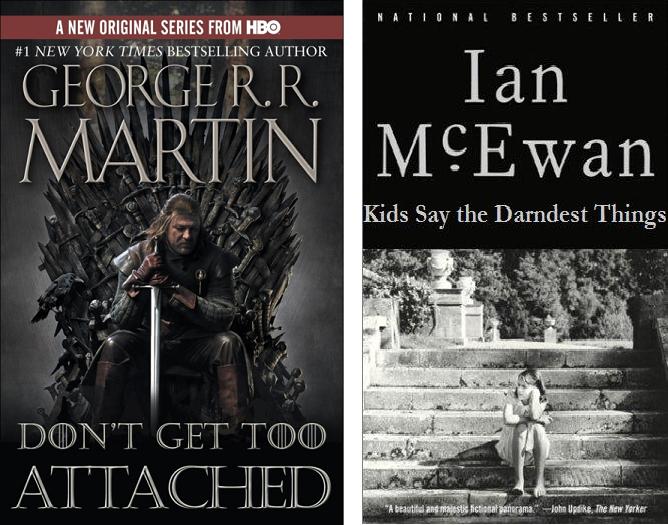
Not sure you have the time or intelligence to read Haruki Murakami's oeuvre?  Too American to read Ian McEwan?  Now all you have to do is click on over to the site Better Book Titles and you can get the gist of hundreds of books without having to read them.  So the next time you go to party and someone asks you, "Did you read "For Whom the Bell Tolls?" All you have to say is "How many pages does it take to blow up a f*****g bridge?" Everyone will laugh and think that you read the book.  Thanks Better Book Titles!

Feb 4, 2012

Books About Passports

Lebanese designer Marwan Kabour has designed a set of five books that take on different aspects of international travel.  The books are his response to what he sees as the restricting of travel throughout the world:

PASS/PORT is a set of 5 books in the form of passports that critically investigate the different parts of the travel process. The project attempts to represent the ways the travel document embodies the very essence of restriction rather than allows passage. Our political borders are as closed as ever at a time when our notion of the world is that of a global village or an open city.

 This is a great lead-in for a book review  one of my favorite books of 2011  The Passport: A History of Man's most Traveled Document

Jan 26, 2012

Volcanoes, Strange Patronyms, Small Horses, and Books

A nation of 300,000 highly educated people where everyone* reads books.  Bookstores run by experts.  No anti-intellectualism (political candidates pretend to be smart instead of confess to being dumb).  No competition with Amazon.  Three year-olds can pronounce Eyjafjallajökull.  Government funding for publishing.  What is this fantasy land? why Iceland of course.  I can't believe you didn't guess that.  Thanks for the heads up
The Itenerant Librarian
Source: the Bookseller.com

*I'm sure not everyone, someone would rather watch The Real Housewives of Reykjavik.